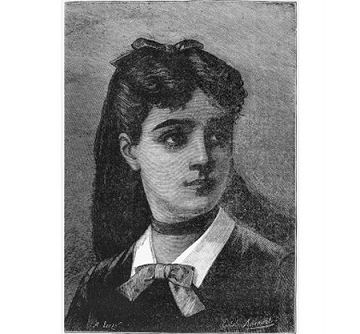
Links for Sophie
Germain
1776-1831
|
|---|
Sophie Germain's grand plan to prove Fermat's Last Theorem,
video of lecture by
David Pengelley, 2020.
|
Thank
You, Sophie, and I'm Sorry, Scientific American article by
Evelyn Lamb, 2017
"I'm sorry, Sophie, that the world was not ready to
recognize or nurture your genius. I'm sorry you were never Professor
Germain. I'm sorry that medicine could not heal you or ease your pain
at the end. And I'm sorry for the thousands of other women just as
bright as you who never got to share their gifts with the
world."
|
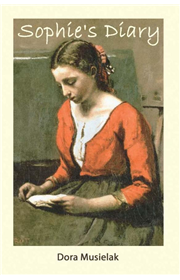
Sophie's
Diary by Dora Musielak, 2004, 244
pages.
 |
"I was inspired to write Sophie's Diary to honor Sophie Germain, to
make her known to new generations of girls, and to promote her
achievements. Knowing so little about her childhood, I wanted to
present a perspective as to how the teenage Sophie must have learned
mathematics on her own. Writing Sophie's Diary became my way of
bringing Sophie to life.
What I wanted most of all was to put into context the
environment surrounding the young Sophie Germain who, against all
odds, became one of the greatest women mathematicians in history. Long
ago, when I first learned about Germain, I was immensely impressed by a
woman, who not only lived during a time of great social turmoil but
grew up in an era when women were not permitted in the
universities. History records the achievements of other great female
mathematicians who lived before and accomplished as much, but Sophie
Germain did it alone. Hypathia had her father, Theon of Alexandria to
teach her; Maria Agnessi had her Rampinelli and other instructors; and
Emilie Chatelet had Maupertuis and Clairaut as her tutors of
mathematics. Sophie Germain had no teacher."
Review
by David Pengelley in
The Mathematical
Intelligencer, 2010.
"Can a fictional teenage diary of
the mathematician Sophie Germain have dramatic and captivating appeal
to audiences ranging from curious teenagers to professional
mathematicians? The answer lies in the delicate balance between what
we do and don't know about her real life, along with the extraordinary
historical and mathematical circumstances that coalesced with her
stranger-than-fiction initiative, perseverance, and mathematical
talent, to make her the first woman we know to achieve important
original mathematical research."
If you are going to follow just one link on this
page, read this
review!
|
|
|
|
"Voici
ce que j'ai trouve [Here is what I have found]:" Sophie
Germain's grand plan to prove Fermat's Last Theorem,
2010.
Seventy-five page article by
Reinhard
Laubenbacher and David Pengelley
on Germain's recently discovered work on number
theory.
"A study of Sophie Germain's extensive manuscripts on
Fermat's Last Theorem calls for a reassessment of her work in number
theory. There is much in these manuscripts beyond the single theorem
for Case 1 for which she is known from a published footnote by
Legendre. Germain had a full-fledged, highly developed, sophisticated
plan of attack on Fermat's Last Theorem. The supporting algorithms she
invented for this plan are based on ideas and results discovered
independently only much later by others, and her methods are quite
different from any of Legendre's. In addition to her program for
proving Fermat's Last Theorem in its entirety, Germain also made major
efforts at proofs for particular families of exponents. The isolation
Germain worked in, due in substantial part to her difficult position
as a woman, was perhaps sufficient that much of this extensive and
impressive work may never have been studied and understood by anyone."
|
An
Attack on Fermat, two part article in Science News Online,
February 23 and March 1, 2008.
Sophie Germain was the
first to propose a realistic plan to prove Fermat's Last
Theorem.
"The mathematician who developed the approach
was respected by luminaries like Carl Friedrich Gauss,
Adrien-Marie Legendre, and Joseph-Louis Lagrange, but was
marginal in the mathematical community, with no formal
training or university position. That's because the
mathematician was a woman, indeed, the first woman to do
significant research in mathematics." |
A
Woman Who Counted by Barry Cipra, article in the February
2008 issue of Science.
"Sophie Germain was one of the great mathematicians of
the early 19th century. Number theorists laud her for 'Sophie
Germain's theorem,' an insight into Fermat's famous equation
xn + yn = zn aimed at establishing
its lack of solutions (in positive integers) for certain
exponents. Oddly, Germain's fame for her theorem stems not from
anything she herself published but from a footnote in a treatise by
her fellow Parisian Adrien-Marie Legendre, in which he proved Fermat's
Last Theorem for the exponent n = 5. Now, two mathematicians have
found that Germain did far more work in number theory than she has
ever been given credit for.
Poring over long-neglected manuscripts and correspondence, David
Pengelley of New Mexico State University in Las Cruces and Reinhard
Laubenbacher of Virginia Polytechnic Institute and State University in
Blacksburg have discovered that Germain had an ambitious strategy and
many results aimed at proving not just special cases of Fermat's Last
Theorem but the whole enchilada. 'What we thought we knew [of her work
in number theory] is actually only the tip of the iceberg,' Pengelley
said at a session on the history of mathematics. "
|
Wikipedia
article
Includes an excerpt from Gauss' letter to her
after learning that she was a woman,
and explains how she blew
her cover in order to save his life.
"But how
to describe to you my admiration and astonishment at seeing my
esteemed correspondent Monsieur Le Blanc metamorphose himself
into this illustrious personage who gives such a brilliant
example of what I would find it difficult to believe. A taste
for the abstract sciences in general and above all the
mysteries of numbers is excessively rare: one is not
astonished at it: the enchanting charms of this sublime
science reveal only to those who have the courage to go deeply
into it. But when a person of the sex which, according to our
customs and prejudices, must encounter infinitely more
difficulties than men to familiarize herself with these thorny
researches, succeeds nevertheless in surmounting these
obstacles and penetrating the most obscure parts of them, then
without doubt she must have the noblest courage, quite
extraordinary talents and superior genius. Indeed nothing
could prove to me in so flattering and less equivocal manner
that the attractions of this science, which has enriched my
life with so many joys, are not chimerical, [than] the
predilection with which you have honored it."
|
Math's
hidden woman from the PBS documentary on Fermat's
Last Theorem, The Proof.
Its
assertion that she stopped working on FLT after 1808 is
incorrect. She worked much more on it and made some important
discoveries that were never published. See the next link below.
"Germain's contribution would have been forever wrongly
attributed to the mysterious Monsieur Le Blanc were it not for the
Emperor Napoleon. In 1806, Napoleon was invading Prussia and the
French army was storming through one German city after
another. Germain feared that the fate that befell Archimedes might
also take the life of her other great hero Gauss, so she sent a
message to her friend, General Joseph-Marie Pernety, asking that he
guarantee Gauss's safety. The general was not a scientist, but even he
was aware of the world's greatest mathematician, and, as requested, he
took special care of Gauss, explaining to him that he owed his life to
Mademoiselle Germain. Gauss was grateful but surprised, for he had
never heard of Sophie Germain. " |
Sophie Germain and Fermat's Last Theorem
Sophie's long known work on Fermat's Last Theorem.
"We now know, of course, that Fermat's Last Theorem is
true for every value of n > 2 thanks to the crowning work of Andrew
Wiles, first described in 1993 and then published in 1995. But as
L.E. Dickson wrote in 1917, This challenge problem
has received attention of many mathematicians of the highest ability,
including Euler, Legendre, Gauss, Abel, Sophie Germain, Dirichlet, Kummer and
Cauchy."
|
Encylopedia
Britannica article
"As a girl Germain read widely in her fathers library and
then later, using the pseudonym of M. Le Blanc, managed to obtain
lecture notes for courses from the newly organized École Polytechnique
in Paris. It was through the École Polytechnique that she met the
mathematician Joseph-Louis Lagrange, who remained a strong source of
support and encouragement to her for several years..."
|
St. Andrews
biography
"At the age of thirteen,
Sophie read an account of the death of Archimedes at the hands
of a Roman soldier. She was moved by this story and decided
that she too must become a mathematician..."
|
Sophie
Germain: Revolutionary Mathematician
"On the establishment in 1795 of the Ecole Polytechnique,
which women could not attend, Germain befriended students and obtained
their lecture notes. She submitted a memoir to the mathematician
J. L. Lagrange under a male student's name. Lagrange saw talent in the
work, sought out the author, and was bowled over to discover it had
been written by a woman. She continued to study, corresponding with
leading mathematicians of the day...."
|
“Voici
ce que j´ai trouv´e:” Sophie Germain’s grand plan to
prove Fermat’s Last Theorem, 2010, (76 pages)
by
Reinhard Laubenbacher and David Pengelley
A study of Sophie Germain's extensive manuscripts on
Fermat’s Last Theorem calls for a reassessment of her work in number
theory. There is much in these manuscripts beyond the single theorem
for Case 1 for which she is known from a published footnote by
Legendre. Germain had a fully-fledged, highly developed, sophisticated
plan of attack on Fermat's Last Theorem. The supporting algorithms she
invented for this plan are based on ideas and results discovered
independently only much later by others, and her methods are quite
different from any of Legendre's. In addition to her program for
proving Fermat's Last Theorem in its entirety, Germain also made major
efforts at proofs for particular families of exponents. The isolation
Germain worked in, due in substantial part to her difficult position
as a woman, was perhaps sufficient that much of this extensive and
impressive work may never have been studied and understood by
anyone.
|
Top
10 Early Female Mathematicians
A list that includes Sophie
Germain, Ada Lovelace (Augusta Byron, Countess of
Lovelace) (1815-1852)
and Amalie Emmy Noether (1882-1935). |
|
|